Introduction: A Journey Within
Dear Readers, welcome to SC Musings
SC Musings takes me on introspective journeys, traversing past times and spaces and connecting them with the now.
Did you take a peep into your psycho-social boundaries? Did they speak to you?
When I glance at boundaries now, my own narrative surfaces. The oneness of identity I experienced during my growing-up years has receded into the background. Yet, it lingers there, giving me a sense of expansive awareness and making it easier for me to experience a sense of oneness with the universe.

In this blog, we will explore the psychological and social dimensions of psycho-social boundaries independently before bringing them together in the context of the NG Holistic Model of a Human Being.
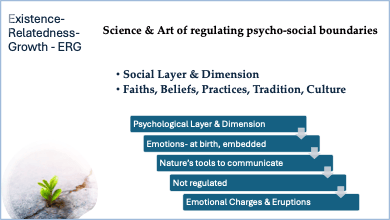
Our purpose is to experientially explore the science and art of regulating psycho-social boundaries. We believe that this regulation is essential for ERG — Existence, Relatedness and Growth (Alderfer, 1969).
1. Exploring the Psychological Dimension
The psychological dimension is present from birth and provides a vital connection with significant others and our environment. A newborn baby’s cry is one of the earliest expressions of this connection.
As the infant grows, the psychological layer, influenced by biological and biochemical processes and expressed neurophysiologically through behaviour, is progressively shaped by social regulations and conditioning.
Here, I attempt to capture the multitude of agents and processes underlying the formation of our psychological dimension and layer.
Emotions: Nature's Tools for Engaging with the World

Although we have advanced technologically, our understanding of the psychological layer remains at an evolving stage. Even technologically and economically developed societies continue to experience conflicts charged with emotions.
The exploration of positive emotions has gained momentum over the past three decades and more. Inspired by the Dalai Lama, neuroscientist Richard Davidson explored emotions such as compassion and joy and their relationship with the brain and well-being (Davidson, 2016). This work has helped bring greater attention to the role of positive emotions in mental health.
Learning from Eastern Wisdom
Eastern psychology has explored emotions through metaphors, philosophical insights and practices (Yati, 1987, 2013). Yet, these insights are not always readily accessible, even in the East, where Western approaches have become influential.
I began to comprehend the depth of Eastern wisdom and its applicability to everyday life through the teachings of Guru Nitya Chaitanya Yati, and later through the writings of Sri Aurobindo and the Mother.
During a recent visit to Koni Gurukula in Kerala, I learnt that Guru Nitya had sat in silence for 18 months following a difference with his Guru.
I find this particularly interesting. What tool did Guru Nitya use to engage with his emotions and relationship during this period?

The silence invites us to reflect on the many ways in which we engage with emotional experiences and relationship challenges. It also raises a question: can we create the inner space needed to observe our emotions before responding to them?
The profound psycho-social-spiritual message of Narayana Guru points towards oneness through peace and harmony.

Rather than succumbing to the temptation we psychologists sometimes have to lift practices and prescriptions out of their original contexts and apply them mechanically to our lives and work, I have begun delving more deeply into my inner terrain.
Transactional Analysis (TA), Tai Chi, and classes with Nancy Yeilding — my mentor, a disciple of Guru Nitya and Head of Bainbridge Gurukula — guide me in this inward journey.
2. Exploring the Social Dimension
Surveying our social dimension and layer is relatively simpler because of its visibility and accessibility.
Socialisation begins at birth, if not earlier, in the womb, where transgenerational influences may shape our experiences and patterns of relating (Berne, 2015, pp. 39–41; Gayol, 2004).
Our social layer and dimension comprise the faiths, beliefs, traditions and cultural influences that seep into our system through socialisation.
Unlike the psychological layer, which is embedded in deeper levels of consciousness, the social layer, though deep and multidimensional, is more readily visible in our communications, behaviours, relationships and the environments we create and inhabit.
We can observe the social layer in everyday life:
- The beliefs and values we express.
- The traditions we uphold or question.
- The ways we communicate and respond to others.
- The expectations we carry into relationships.
- The social environments we create and participate in.
These visible expressions offer us opportunities to reflect on the influences that have shaped us.
3. Bringing the Psychological and Social Dimensions Together
In last Blog, we explored how Transactional Analysis helps us understand our psychological and social dimensions through ego states (Berne, 2015).
The Child ego state can be understood as a repository of experiences from early life and beyond, influencing how our past shapes our personality in the present. The Parent ego state is experienced through our inner voice and may also manifest in our behaviours towards others.
Having explored the psychological and social layers independently, we can now examine how they interact.
Our emotional expressions are influenced by social conditioning. At the same time, we interpret social norms through our own psychological propensities and adapt them to suit our needs, dispositions and experiences.
Thus, the influence is reciprocal.
We are shaped by our social environment, and we also interpret, respond to and influence that environment through our psychological make-up.
Why Is This Integration Important?
The intricate integration and interweaving of our psychological and social layers make human beings complex and sometimes unpredictable.
A person’s behaviour cannot always be understood by examining emotions, beliefs or social circumstances in isolation. The interaction between these dimensions adds layers of complexity to our responses and relationships.
The Bengaluru CEO’s crime, reported in January 2024, brought disturbing questions about human behaviour into public consciousness. Although an individual case cannot explain human behaviour in general, it reminds us that understanding human beings is a complex undertaking.
Understanding alone may not provide all the answers or lead to meaningful change. We also need to examine our own responses, recognise our conditioning and develop the capacity to pause and reflect.
4. Psycho-Social Boundaries: A Pause for Reflection
Caught in the complexity of human relationships, we often find ourselves navigating questions of right and wrong, just and unjust.
We may take a microscopic view of ourselves, others and our environment, without adequately factoring in time, space and the wider context.
In such moments, pressing the pause button and looking at our psycho-social boundaries can offer a respite.
This pause is not simply an intellectual exercise. It calls for an inner journey of reflection and contemplation — an opportunity to observe what arises within us and how we experience the boundaries between ourselves and others.
This is the journey we will explore further in next Blog.
A Reflection for You, Dear Reader
I invite you to allow thoughts or images of your boundaries to arise within you. Simply witness them.
- What comes to mind when you think of your psycho-social boundaries?
- Who or what do you find within these boundaries?
- How do you experience these boundaries in your relationships?
- What sensations arise in your body when you become aware of them?
There is no need to rush towards answers. Allow yourself the time and space to notice what emerges.
Sometimes, the beginning of understanding lies in observing without immediately judging, explaining or changing what we experience.
Pause. Observe. Reflect.
In our next blog, we will explore strategies to regulate our psycho-social boundaries.
Until then, I invite you to continue this inward journey with curiosity and openness.
References
Alderfer, C. P. (1969). An empirical test of a new theory of human needs. Organizational Behavior and Human Performance, 4(2), 142–175.
Berne, E. (2015). Transactional Analysis in Psychotherapy: A Systematic Individual and Social Psychiatry. Martino Publishing. (Original work published 1961).
Davidson, R. (2016). The Science of a Happy Mind, Part 1. National Geographic Live. https://www.youtube.com/watch?v=ELLeIMFIWy0
Gayol, G. N. (2004). Codependence: A transgenerational script. Transactional Analysis Journal, 34(4), 312–322. https://doi.org/10.1177/036215370403400404
Yati, G. N. C. (1987). The Psychology of Darsanamala. D. K. Printworld.
Yati, G. N. C. (2013). That Alone, the Core of Wisdom: A Commentary on Atmopadesa Satakam, the One Hundred Verses of Self-Instruction of Narayana Guru. D. K. Printworld. (Original work published 2003).
Additional media reference
Nation Numbed by Bengaluru CEO Mother’s Crime: Disturbing Revelations in Goa Murder Case (2024). https://www.youtube.com/watch?v=WtroXLmOYIk&t=2s